A Neighbourhood Welcome Table for a New Season
A neighbourhood welcome table helps neighbours meet, trade local knowledge and feel at home in a shared room, without turning a friendly gathering into a public meeting.
How can you help neighbours feel at home in a shared room without asking them to join a campaign or speak for anyone? A neighbourhood welcome table gives people a reason to meet, share local knowledge and enjoy a social gathering with no decision to make.
Keep that purpose visible. This is a chance to learn names, swap stories about the area and get to know the people who share it—not a consultation, committee meeting or informal vote. The distinction lets conversation remain light and prevents guests from assuming their comments will shape an official decision.
Describe the gathering as social, not consultative
Use a direct invitation: neighbours are welcome to meet, chat and share what they enjoy about the area. Say plainly that there will be no formal discussion or decisions. People can arrive late, stay briefly or simply listen.
Give the practical details guests need: the room’s familiar name, which entrance to use, the time window and whether tea or other refreshments will be available. If a community room is inside a library or housing co-operative, add a simple direction such as “use the side door beside the noticeboard”.
Share the invitation through places neighbours already use, such as a residents’ newsletter, a library noticeboard or local community groups. Ask people to pass it on as an invitation, not an obligation. If access is limited by a booking arrangement or room capacity, explain that before the day.
Make a room that encourages casual company
Set chairs in small clusters or a loose oval rather than a row facing a speaker. Leave an easy route from the entrance to the seats, and keep coats, pushchairs and bags from narrowing it. A few seats just outside the busiest cluster give people space to settle without having to join a conversation straight away.
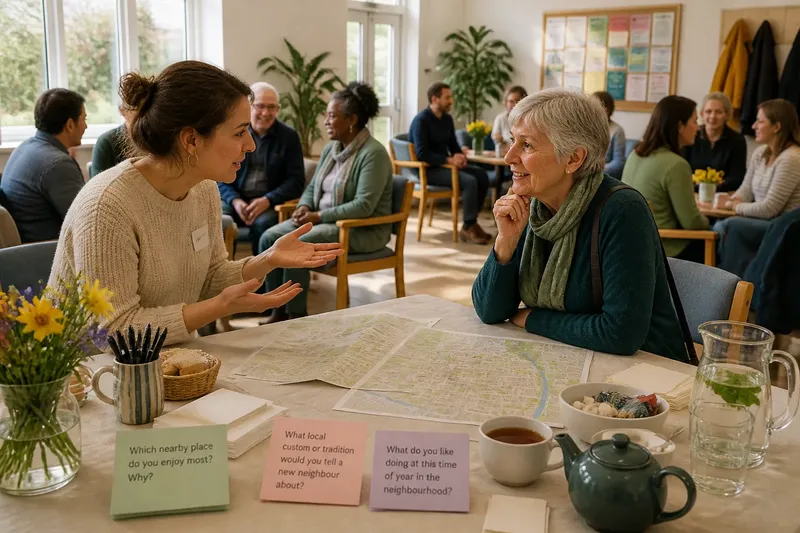
Keep the table useful, not crowded. A cloth, pens, blank cards, a neighbourhood map and a small stack of local notices can give guests something to browse or discuss. Leave room for cups and personal belongings; like a kitchen table, it works better when there is space to set things down.
Choose refreshments that fit the host’s capacity and the room’s rules. Tea, water or a simple snack can make a gathering feel generous, but the event should not depend on elaborate food or decorations.
Give guests ways to connect without assigning them roles
Agree which host will greet people and which will keep an eye on the room. A simple hello, an offer of a seat and a point towards the refreshments are often enough. Do not ask newcomers to introduce themselves to everyone or explain where they live.
Offer conversation starters as optional prompts, not activities people must complete. For instance, a card might ask which nearby place they enjoy visiting, what local custom they would tell a new neighbour about, or what they like doing at this time of year. Guests can answer, browse the map, speak with someone nearby or leave the card untouched.
If you use name stickers, make them optional. Do not collect contact details unless there is a clear, stated reason; a social gathering does not need a sign-in list to feel welcoming.
Use prompts to share local knowledge, not gather votes
Choose questions that invite memories and recommendations rather than requests for policy proposals. “Where do you like to sit outside on a sunny day?” can start a relaxed exchange. “What should the council change?” shifts the room towards public decision-making, which is a different event with different expectations.
If a guest raises a concern about a local service, listen without promising an outcome or turning the table into a debate. You can ask whether they would like help finding the appropriate council contact, then return the conversation to the social purpose if they agree.
- If a guest shares a favourite local place, ask what makes it enjoyable; if they prefer not to elaborate, let the conversation move on.
- If someone brings up a local tradition, invite others to share their own; if the exchange becomes uncomfortable, offer a different prompt.
- If a guest asks whether comments will reach a decision-maker, clarify that the gathering is social; if they want to submit a view, point them towards the relevant official channel instead.
- If one person dominates a conversation, offer a fresh prompt or open a second chat; if the group prefers to continue, let it do so without forcing a round-robin.
- If a newcomer seems unsure where to join, offer a quiet introduction; if they decline, show them a seat or the refreshments and leave the choice with them.
- If the map or cards attract a crowd, move them to a free corner of the table; if the table becomes too busy, set the materials aside so guests can talk comfortably.
Say you are hosting a spring gathering in a shared community room, with a neighbourhood map, blank cards and tea on the table. A guest arrives alone and asks whether the cards are for a council consultation. You explain that they are optional conversation prompts and that nobody is collecting responses; the guest browses the map, spots a familiar park and starts talking with another visitor about it. The result is a shared local conversation, not a record of public opinion or a decision.
Keep the host’s role friendly and low-key
The host is there to help people meet, not to lead a programme. Notice when someone is left out, offer an introduction if it seems welcome and accept a refusal without pressing. A short opening line can set the tone: “This is a chance to meet neighbours; there’s no agenda, so please help yourself to a seat or a cup of tea.”
If a conversation becomes heated, acknowledge the difference and steer back towards the gathering’s purpose. You might suggest a quieter conversation elsewhere or offer a neutral prompt. Avoid implying that the room can resolve a dispute or speak for the whole neighbourhood.
Close at the time stated in the invitation. Thank people for coming and mention another gathering only if one is actually arranged. Afterwards, discuss practical details with any co-host: whether the entrance was easy to find, whether the seating encouraged conversation and whether the room needs a different layout next time.
What should guests know before they arrive?
Do I need to register?
Say whether guests can simply turn up or should contact a host first. If room planning makes a reply useful, explain how to get in touch and provide an alternative for someone who cannot use that channel.
Can I come alone and stay briefly?
Yes, if the invitation makes that clear. Let guests know they can visit for a short time and leave without explaining why.
Will anything I say influence a local decision?
Not at a social welcome gathering, unless the invitation explicitly says otherwise. If a guest wants to raise an issue formally, point them towards the relevant council or community organisation rather than implying that casual conversation will be passed on.
What if I do not know anyone?
Start with the greeter, take a seat or browse the map and conversation prompts. Hosts can offer an introduction, but should leave the guest free to decline or take time to settle in.
End with a clear, friendly cue
As the gathering winds down, thank guests for coming and say whether another social event is planned. If there is no next date, simply leave the door open for neighbours to meet again without suggesting a programme that does not exist.
A neighbourhood welcome table works when guests understand what it offers: friendly company, a chance to exchange local knowledge and no pressure to represent anyone or reach a decision. Keep that promise clear in the invitation and in the room, and the gathering can remain a genuinely social place to meet.