The Open-Door Myth: Access Takes More Than an Invitation
Public meeting access improves when invitations arrive in time, explain the decision and provide a reliable contact, helping residents judge how to take part.
Why can a public meeting invite everyone and still be hard to join? Public meeting access depends on the journey from first hearing about a meeting to deciding whether and how to take part. The notice, supporting material and first contact should help a resident make that decision without already knowing how the institution works.
Imagine a neighbourhood council discussing changes to a local park. Its notice says the meeting is open to residents but does not explain whether registration is needed or what part of the plan remains undecided. A resident who works evenings spots the notice late; another wants to understand the proposal before deciding whether the meeting is relevant. The issue is not how the room is run, but whether either person can make an informed choice before getting there.
Public meeting access starts with a decision-ready notice
A useful notice lets readers answer three questions: Is this issue relevant to me? What can still be influenced? What do I need to do if I want to contribute? Put the decision at the centre, rather than relying on labels such as “consultation” or “stakeholder session”.
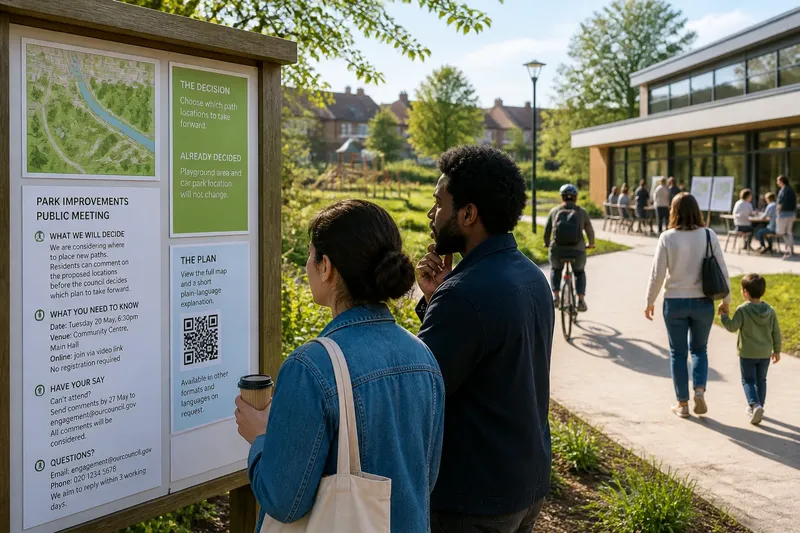
For the park discussion, the council could write: “We are considering where to place new paths. Residents can comment on the proposed locations before the council decides which plan to take forward.” If some parts are already settled, name them too. This gives people a fair basis for choosing whether to spend time on the discussion.
Include the date, venue or online access details, whether anyone must register, and a contact route. If people may attend without signing up, say so directly. If a document or map is needed to understand the proposal, link it from the notice rather than making readers search for it.
Give residents time and usable material before they respond
A notice sent shortly before a meeting may leave little room to arrange work, care or travel. Send the essential information early enough for people to consider it, then use a reminder to repeat the date, purpose and contact details. Do not assume that a second message will reach everyone who missed the first.
Timing is also about what residents can review in advance. Pair a technical plan with a short plain-language account of the decision, and label maps so readers can tell what each mark represents. If translation or interpretation can be requested, explain how to ask and who will receive the request.
When the chosen meeting time will not suit everyone, make an alternative contribution route visible in the same notice. For example, explain where to send written comments and whether they will be considered alongside comments made at the meeting. A route that is hard to find or disconnected from the decision is of little use.
Use the first contact to answer practical questions
Give residents one recognisable way to ask about the invitation: a monitored email address, a phone line or a named team. Avoid sending someone from department to department to learn whether they can attend. The contact should be able to answer basic questions or take responsibility for finding the answer.
A clear reply deals with the question first, then gives the next useful detail. If a resident asks whether registration is required, say yes or no and explain what to do next. If they ask for the proposal in another format, state how to request it and when to expect a response if that information is available.
Think of this contact route like a labelled postbox: it does not resolve every issue, but it shows where a question should go. Keep the invitation’s contact details consistent across its paper and online versions, and check that the route is monitored before publishing it.
Check each access detail before publishing the invitation
Use this check before sending a notice. For each observation, make the stated decision; if the condition is not met, take the alternative action before publication.
- Check whether the notice names the decision residents can influence. If it does, publish that wording; if it does not, ask the responsible officer to identify the open decision before sending the notice.
- Check whether the invitation states who may attend. If the audience is clear, keep the wording; if it is vague, name the eligible residents or groups and clarify any limits.
- Check whether registration is required. If it is not, say people may arrive without registering; if it is, give the sign-up method and a contact for questions.
- Check whether the date and participation details arrive early enough for residents to make arrangements. If they do, send the notice; if they do not, reconsider the schedule or provide another way to comment.
- Check whether the proposal can be understood from the linked material. If the map or document is clear on its own, link it; if it relies on unexplained terms, add a plain-language explanation and labels.
- Check whether the listed email or phone route is monitored. If it is, publish it; if it is not, replace it with a working contact and verify that questions reach a responsible person.
- Check whether residents who cannot attend have a stated way to contribute. If they do, explain how those comments connect to the same decision; if they do not, add a genuine alternative or state honestly that none is available.
What should a resident be able to find before deciding?
Can I attend without registering?
The notice should say plainly whether people can arrive without signing up. If registration is required, it should give the method and a contact for help with the process.
What can residents still influence?
The invitation should identify the choice that remains open and any limits already set. That lets a reader judge whether their contribution could bear on the decision.
Where can I get the proposal in a usable form?
Link the relevant plan or document and include a short explanation of what it shows. If another format or language is available on request, name the contact route for asking.
Who answers questions about the invitation?
Provide one monitored email address, phone number or team name. A resident should not have to guess which office handles practical questions.
Work through the park notice from draft to publication
Say the council’s draft notice gives the date but says only “public consultation on park improvements”. It also links to a technical map, does not say whether registration is needed and lists a general switchboard. These are the starting inputs for revising it, not facts about a real council.
The organiser first checks which decision remains open and learns that residents can comment on proposed path locations, while the meeting is open without registration. The organiser replaces the vague label with a sentence explaining that choice, states that anyone may attend without signing up, and adds a short explanation beside the map link.
Next, the organiser checks the date against the council’s schedule and decides there is not enough time for residents to review the map and make arrangements. The council moves the discussion to a later date, sends the notice through its resident mailing list and local noticeboards, and adds a monitored email address for questions. It also states how to submit written comments for the same path-location decision.
The resulting notice gives residents a clearer choice: they can see what is open to influence, understand how to attend, review the proposal and ask a question or send a comment. The trade-off is that the council must allow more time and handle another contribution route. In return, the invitation is less likely to exclude someone simply because the first message left essential details unclear.
Make the invitation useful before anyone arrives
Public meeting access is not only a matter of whether a door is open. It also depends on whether a resident can find the invitation, understand the decision, get a timely answer and choose a workable way to contribute.
Before publication, read the notice as someone unfamiliar with the institution would. If the purpose, next action or contact is still unclear, revise it; public meeting access begins when a person can make an informed choice about joining.